3/17/09

GREEN TODAY

Happy St. Patrick's Day. Don't you love these green bubbles - all in the name of art, too.

Check out Mary Jane Noe's new bubble painting here as well as Barbara Sailor's bubble painting here. Rhonda Carpenter's first bubble painting can be seen here, and she has another in progress right now.

Mrs. O'Conner (Irish of course) is all decked out for St. Patty's day. Way to go! Her bubble painting was tops - a claw foot bath tub with a woman in it. It was sophisticated.

Shirley, our Greater Cincinnati Watercolor Society President, seems very intent on what to create with her bubble print. Tomorrow's post will include one of my bubble paintings so ugly that it got washed off in the sink. Have a great day.


3/16/09

COMPARISON

This painting was the very first one of the my Malta street scene series, painted over fifteen years ago. Common masking tape was used to create - or actually protect - each new shape before paint was put down.
.
Plain masking tape was torn or cut into the proper shapes then placed anywhere I didn't want the paint to go. Each new layer of paint was one value darker than the last one, with the colors painted almost randomly without regard for what object was being painted. After each layer of paint dried, more tape was torn or cut to fit the next shapes that I didn't want paint on. This process continued for seven layers of tape and paint.
.
The advantage of using masking tape this way is that the wet paint sneaks under the edges of the tape and creates a unique, batik-like look. When the tape was removed, some corrections were brushed in to adjust edges or values, and the wall on the right had to be repainted a lot. The fence and details of the lamp were brush painted, too.
.
Compare this with the recent posts of the same scene to see what a difference technique choices can make on a painting. This is one of my paintings that I wish I still owned, but an architect bought it years ago. It was my first successful 'tape' painting, and although the lines and shapes were somewhat crookedy, I really enjoyed looking at its unpredictable qualities. Or maybe the crookedy part was my favorite part. (That's not a real word...but it describes it pretty good.)
.
Plans are in the making for painting it again soon with hot wax batik and watercolor. Once that one's done, I'll post the photos of five different paintings done from this photo of Malta, each created with different techniques. Although I've painted this picture at least a dozen times, I sometimes (often) neglected to take photos of my work. So, now I have no record of those other paintings. (Thank goodness for the convenience of digital cameras.)
.
"LIGHT UNTO MY PATH #1" Transparent Watercolor on 140#CP Arches 11 x 15" COLLECTED

3/12/09

NEW APPROACH - OLD FAVORITE

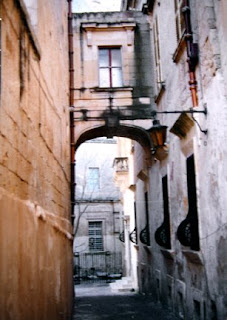
This photo, one my sister took in Malta, has been a source of inspiration for me to paint from over the past fifteen years. The March 7th post (WARMING UP) shows one of those completed paintings, but here the image has been reversed. The approach and techniques used are also very different than before when I painting this same subject.

The black and white image (above) relates to the basic light shape in the photo. In that simplified design, there are three black shapes with one continuous white shape, which goes off the page on three sides. That white shape's was transferred to the watercolor paper and was left white - unpainted - in the few first steps of the painting.

The first layer of paint was very, very pale and was also the opposite temperature of the finished painting. Some of the painted edges creeped into that white shape more than I

wanted, but they'll be ok.

The gray areas shown around the balcony, the door, window panes and the upper window, and in the light are not paint, but actually gray miskit painted on the paper to keep it totally white. There are some splatters of miskit in various places, too, especially in the walkway. It'll all be removed later.

Next, a few small warm dark shapes were added within the painted areas, touching the white shape somewhere. You can see a variety of edges, from sharp, hard edges to soft to disappearing edges in the dark shapes. The contrast of dark and light helps establish the basic range of values early in the painting.

To finish the painting, the largest areas must be painted first, then medium sized shapes, with the smallest details added last. The next couple of photos represent the gradual progress of painting from large to small.

Areas that used to be pure white are adjusted, and the original white shape seems to slowly disappear. That good white shape was important to help establish unity to the final painting. The white shape won't be visible when the painting's done, but that part of the painting will have the best glow and the purest colors.

I enjoy using as many sedimentary colors as possible in paintings like this to take advantage of the textures created by the granulating colors. Lots of violet has been added to the warm oranges and yellows on the walls, and the only brown used was Quinacridone Burnt Orange.

That initial cool glaze over two thirds of the painting helped quiet down or 'gray' the outer edges of the warm colors. The subtle graying of those warms away from the focal area actually makes the focal area have more impact and seem to glow more.

There are several stages of this painting shown here so you can compare each progressive stage of the painting. Once the upper right hand windows had some color on them, I applied miskit over the lighter parts of the windows to preserve the shutter highlights. After darken that window area, the miskit on the windows was removed. In the third to last picture, the miskit has finally been removed from around the door area, exposing pure white paper.

The last two pictures seem almost the same. In the last picture, the lamp has been separated from the archway and detail added to the boarded up windows. The tree was lightened a bit and the balcony shadows darkened. The last thing painted was to darken the top panes in the upper window to anchor it better.


.
.
.
.
.
"CAUGHT UP IN THE MOMENT" Transparent Watercolor on 140#CP Arches 18 x 24" COLLECTED

3/11/09

SEE IT NOW! BRUSH-PAPER-WATER

It's not too often that we meet a 'giver' who gives with no expected return. Then there's Chris Beck. She started her own art blog, then quickly decided to start another blog with the sole purpose of featuring other watercolor artists.

This week at BRUSH-PAPER-WATER, Chris chose to feature my work and took the time to write up a nice bit of info about my art journey. She really knows how to make a person's day! Click on over to the blog for a look-see and be sure to stop in at her art blog, too, to check out her dynamite adventures with her brush.

Thank you, Chris, for being so generous with your time and talents, for encouraging others, for promoting watercolor and artists. You are so appreciated!
.
This painting was posted on this blog a long time ago but seemed appropriate today, too. It's a good journey when life is full of good friends and art. Like CHRIS!
.
"OXFORD CIRCUS" Transparent Watercolor on 140#HP Arches 30 x 22" COLLECTED

3/10/09

ORANGE HOT SPOTS

This was posted earlier, but here it is again with some small orange hot spots popped into the painting. Clicking on the image will enlarge it enough to better see the orange hot spots as well as the textures.

No more changes can be made since Diane took it home with her on Friday. It can be very hard to know when a painting's finished. For me, it seems the only way that I'm ever positively sure that my painting's really finished is when someone else owns it.

Several paintings - some which had even won awards - have been taken out of their mats and frames in my studio so that I could work on them again. A few re-do's from the past were ruined in the tweaking process, too, so at least I've learned to go forward more cautiously.

"RIVER WALTZ" Transparent Watercolor on Heavy Weight YUPO 19 x 28" COLLECTED

3/9/09

BUBBLES TO THE RESCUE

Several of my classes have 'painted' with bubbles, then created a painting from the bubble print. On Thursday, Suzanne mentioned printing her pomegranate picture with the bubbles. BRILLIANT IDEA! So I stole her idea and printed mine, too.

The original (below) was okay but the addition of the burnt orange bubbles seem to add a much needed texture and interest to this simple still life, as well as contributing more unity by slightly warming the background. The thin bubble lines compliment the pen and ink, too. Thanks so much, Suzanne.

One of things we all value in the classes is the creative synergy that occurs. Although many say that art is a solitary occupation, it's evident that artists creating together build on each other's energies and input, especially when the atmosphere is so positive and encouraging.
I spend a lot of hours planning and painting alone in my studio but do think I paint better when I'm with other artists. It's certainly more fun, too.

"THREE OF A KIND" Pen & Ink with Fluid Acrylic and Fluid Acrylic Bubbles on 140#HP Arches 15 x 9" COLLECTED

3/7/09

WARMING UP

Check out the difference between this painting and the cooler version below. The 'blue' painting is the original, painted on gessoed watercolor paper several years ago.

This week, that blue finally got to me, so I dug out my mouth atomizer, diluted some transparent pyrrol orange fluid acrylic in water, then sprayed or actually 'misted' the blue painting to warm it up. Those ancient streets just looked wrong in cool colors.

A few small blue shapes were taped off before spraying, like the walk in front of the fence and parts of some windows. It would have been impossible to glaze paint over the surface because the friction from my paint brush would've easily lifted the existing watercolor paint right off of the gesso.

Once the orange dried, darks were added on the left hand side, and the sky area was darkened a lot to decrease the importance of its shape. A smattering of burnt orange was touched into the distant wall and more warms added to the lamp. Some of the darker shapes were darkened even more, and the fence was extended over to the wall.

A new painting is in the works right now of the same subject, but the approach is very different this time. The temperature dominance WILL be warm, for sure. It'll be posted once it's completed.

"MALTA EVENING" Transparent Watercolor with Fluid Acrylics on 140#CP Gessoed Arches, 15 x 21"

3/6/09

PATTERNS & POSSIBILITES

Shapes capture more attention when they have some diagonal movement to them. This painting is about placing recognizable, diagonally oriented shapes together to create a patterned painting. It leans slightly toward a grid look or checkerboard composition.

Watercolors - five different colors - were washed over the paper initially, with many blossoms and textural effects encouraged to occcur in the wash. Then opaque gouache watercolor was added to enhance, define, and bring out the emphasis of the shapes. Stencils were also used for the lettering, roosters and chickens by using a sponge to lift out each shape from the paint through a piece of precut acetate stencil.

After lifting out the shapes, some areas in the stenciled shape were touched up again with paint. The rooster feathers were left as is, showing the underlying textures, with only the face and leg areas painted with detail.

Repetition was important but couldn't be over done. Temperature dominance was understated but still evident. The use of straight edges in the background against the fluid edges of the birds and egg helped add contrast, too. The painting needed some surprises and stronger contrasts of value to keep it interesting.

The egg has a lot more value changes within a small space than this blog shows. It did turn out really good with just a hint of warmth on the lower side of it. Click on the pix to see the textures along with the chicken wire --- which could have been done with a stencil, but was painted in.

The elements of design that were meant to be emphasized included shape, color, and texture. My natural inclination when painting is to put a very strong emphasis on value, but not this time. The whole process was like going on a mystery trip, since there was no initial plan to go by. Although most of my work is usually preplanned, I really get charged up by the challenges of finding my way in a painting like this.

"THE EGG CAME 1ST!" Transparent Watercolor & Gouache on 140#CP Arches 20 x 14"

3/5/09

FALLING AWAY

Watercolor is often defined as a medium that incorporates the pigment with water to extend it onto the paper. That could include many kinds of paint like tempera paint/poster paint - from grade school - plus opaque watercolor made by mixing chalk with the pigments (gouache) to acrylics to water based inks to casein and egg tempera paint. Even watercolor pencils and crayons technically qualify as watercolor if water is added. But transparent watercolor is what the majority of people 'think' when they hear the word 'watercolor.'
This painting, done on the slick YUPO surface, includes 'regular' transparent watercolor with fluid acrylics over parts of it, with gouache added in thin layers plus water based inks drawn in last. It's a 'watercolor' technically, but PURISTS wouldn't consider it one.

Very few watercolor societies limit the definition of 'watercolor' to mean just transparent watercolor (as PURISTS do.) There's certainly validity in having a group or show for only transparent watercolor paintings because the difficulty and challenge of painting with only transparent watercolor is great. It's good to compare apples with apples in a 'watercolor' show occasionally.

The majority of my paintings are only transparent watercolor, yet it is exhilarating to be able to select whatever medium it takes to produce art. Years ago, I let the restrictive interior "WATERCOLOR POLICE" keep me from trying out other water mediums. My goal was to increase my expertise with the transparent stuff, and I (unwisely) shunned all the other possibilities.

For so many watercolor artists, it can be a big deal to take that first step away from using ONLY transparent watercolor. It was a giant step for me several years ago. However, now, whatever it takes, whatever works - that's what art's about for me, and it certainly allows so much more freedom to be able to express and create.

This painting's title came about partially because of my 'fall' from transparent watercolor. It was one of the very first that I'd tried as I used gouache and acrylics and broke away from the limits I'd set on myself. It's several years old, and tomorrow's post will include another oldie from that time, using gouache, too.

"FALLEN ANGELS" Transparent Watercolor, Gouache, Acrylics, Ink on YUPO 13 x 8"

3/4/09

CHANGING COLORS

Yesterday's painting is a reversal of this painting, but this one includes more background area. The technique of literally pouring watercolor in layers over protected, painted shapes helped develop the glow in the tulips.

The mood in today's post seems livelier, maybe because of the warmer palette. Although the process takes a lot of planning and work, it's so worth it when all those miskit areas are removed to reveal the luminous colors.

A scrubber brush helped soften some edges in this painting, too, but no paint on a brush ever met with the paper. Both paintings are from the archives.

"TWILIGHT" Transparent Watercolor on 140#CP Arches 20 x 14"

3/3/09

OUT LIKE A LAMB

Only a few weeks until spring gets here - we hope... My daffodils are finally poking their leaves out of the soil, but there's no sign of the snow drops yet.

These tulips were painted with layers of miskit protecting the already painted shapes that weren't to get any darker. After each application of miskit dried, color was poured over the wet paper, then allowed to dry, too... more miskit, then more poured paint - with a total of seven layers of poured paint over seven different applications of miskit. No paint brush loaded with paint ever touched the paper, except for signing it.

The batiks and taping techniques on this blog were created with the same process, but with different materials to protect the lighter values. Instead of miskit, masking tape can be torn to cover shapes on the watercolor paper, or hot wax can be painted on washi papers to protect shapes before adding darker values of colors. Whatever's used to protect existing values helps keep the lighter values light and untouched, while the darker values are built up, usually resulting in fresher looking watercolors.

It's a great way to teach the importance of value changes to artists. Color does seem to get all the credit for a good painting, but VALUE really does do all the work - defining shapes, distance, forms, etc.

Watch for a post of another painting of the nearly same tulips tomorrow done with other colors, resulting in a completely different mood. Painting the same picture several times seems to bother some artists, but I enjoy the surprises and lessons that each painting brings, since they all have their own uniqueness.

"PINK PARADE" Transparent Watercolor on 140#HP Arches 21 x 14"

3/2/09

IN LIKE A LION.......

Yesterday's weather was a little 'lion like.' Our mom always told us that if March came in like a lion, she'd go out like a lamb, and I'm counting on it. Spring can't get here soon enough.

This lion actually lives at a zoo with a great view of Lake Michigan, and although he doesn't look too ferocious here, he can really, REALLY ROAR! He was created over eight years ago on YUPO paper, when I was just learning to control the paint on that slippery YUPO surface. Some of the darker detail has been painted with 'tip tapping' brush strokes, which I don't seem to use as much anymore.

The lion looks old and sad, and a little too human, maybe because of the long winters on the lake. Or perhaps he's really the lion in the Wizard of Oz?!?

He was a beautiful and majestic animal and did live with a lovely lioness in his large, serengeti-like confinement. The YUPO painting of her was posted a while ago.

"LIKE A LION..." Transparent Watercolor on YUPO 13 x 18"

3/1/09

BLOWING BUBBLES

Freshly blown bubbles, (made up of 6 oz. water with 3 oz. Dawn Liquid and 2 oz. of fluid acrylics,) created a textured background for this watercolor. Three colors were used in separate containers, and the last two 'printing' of different colored bubbles took place while the original bubble print was still damp on the page. This allowed some areas of the color to mingle on the paper, creating subtle changes in the bubbles.

Once the bubbles/paint mix dried, it was time to develop some kind of painting. This one really suggested the free fall of water from the top of a steep slope, and since I'd recently read The Shack, beautiful Multnomah Falls near Portland, Oregon, came to mind.

A shape was cropped from the original printing to accomodate the composition. Then, trees were added and some areas darkened to enhance the composition and create movement in the painting. Finally, more burnt orange was painted across the top of the falls for a bit of drama.

If you haven't read it yet, check out The Shack. It started a little slow for me, but after a couple of chapters, there was no putting it down. Hope you like it, too.

"TUMULTUOUS" Transparent Watercolor over Fluid Acrylic Bubbles on 140#HP Arches, 8 x 13"

2/28/09

BLUBS & BUBBLES

When visions pop into my imagination, I might try to capture them on paper, but it usually doesn't work. This started out as one of those paintings last week. Envisioning a wonderful forest of quiet trees extending into a spacious white snow bank with a striking contrast of dark and light patterns, I couldn't wait to get started.

After painting the trees and background and leaving the snow area white, I knew it was obviously not going to express what I saw. The unfinished painting was tossed into a drawer.

Then when Wednesday's class got to BUBBLE PAINT, using fluid acrylics mixed with water and Dawn Liquid Soap, I printed the unfinished tree painting with the bubbles. Nothing to loose, I thought, and at least the new texture added some interest to an otherwise drab composition.

BUT --- seeing it flipped upside down changed everything. Now it reminds me of the northwest corner of Indiana with all the smoke stacks that used to pollute the air. Though this was not what was intended initially, it was a good discovery nevertheless, and conveys a vital message, too.

More bubble paintings are on their way, one of them fairly successful. The goal in the class is to develop valid pieces of art by combining the textured surface created with the colored bubbles with additional enhancements or embellishments of paints, inks, and possibly collage. Each artist's work will be individual even the the initial technique was used by everyone.

We all developed small, two-value thumb nail studies to work from for our bubble prints, so some may end up with abstract designs and others with realistic or representational paintings We are expecting really creative results.

"POLLUTION SOLUTION" Transparent Watercolor Covered by Fluid Acrylic Bubbles on 140# HP Arches 12 x 16"

2/27/09

COOL WASH

This was posted yesterday, but since then, a pale blue wash of Cobalt Blue has been added to the background as well as to some of the petals of the flowers. Stronger darks were also added, as per Rhonda's good suggestion on the last post. Maybe better?

Yesterday's post was a little too pale compared to the real painting. This one's more accurate, I think.

The last couple of days have been spent blowing bubbles - paint bubbles! More to come soon on this:-D

"WASHED DAFFODILS" Transparent Watercolor on 140#HP Arches 16 x 12"

2/26/09

SO MANY GOOD CHOICES

One of the things that I love about watercolor is the huge variety of processes and techniques to choose from when painting. After taking many workshops from many wonderful, professional artists, I've enjoyed adapting those techniques to how I paint, eventually passing along the information about the processes to my classes via demos. Credit is duly given to the instructors for their specific techniques that they so willingly share.

Years ago, a friend introduced me to Stephen Blackburn. Deb Ward had been fascinated by his beautiful handling of watercolor, so a bunch of us signed up for his workshop in Lafayette, Indiana. Since then, he has been to the Cincinnati area several times to give workshops ... twice, in fact, to give workshops for people in my classes. One of my original paintings of penguins, shown on the blog on March 24, 2008, was created during one of those workshops.

The daffodil painting shown here was a demo for Tuesday's class based on info that Steve taught us. Posted here are also two stages of the painting before completion.

First, miskit is 'poured' in a 'stream' onto the paper and then spritzed with water to create trickles for it to flow into. It's a lot trickier than it looks to do this part. Once the miskit is dry, paint is poured over the paper, with several colors being applied. Each color can be allowed to dry in between pours, or for more color mingling, the colors can be poured all at once.

Once the miskit's removed, the subject can be established, as it was with this painting, or the subject could be determined ahead of time before pouring. I do a detailed value study of the drawing in order to know where NOT to paint. For the most part, the picture is developed by painting behind the subject matter, with those darker values popping out the focal areas. This 'negative' painting preserves the beautiful results of the poured paint over the ruffly miskited areas, allowing them to remain untouched.

The final look couldn't ever be achieved with a brush. The unique textured surface created with the poured miskit and paint adds so much to the final painting, making it more unique and intriguing to look at. Thanks, Steve, for sharing your discoveries with us.

Steve won the top award several years ago in International Artist Magazine for one of his exquisitely rendered sunflowers done with his technique. He's a master artist who has developed his very own technique of creating beauty, and he willing shares his techniques in his workshops. Deb's invited him to return to Cincinnati to teach another workshop in May. Hop over to her website - http://www.debwardart.com/ - for more information about the workshop, but hurry. Several people from my classes have already signed up.

Pop over to Steve's instructional website, where you can sign up for his newsletter, too. If you click on the workshop page, you'll see him in action at one of the workshops he taught in my studio. Here's the link - http://www.learnwatercolors.com/

Next month, watercolor artists from around the country will enjoy being at Kanuga Watercolor Workshops near Hendersonville, North Carolina. I've been able to be there for most of the last dozen years to continue learning more about creating art. I'm one of those people who think that learning never ceases and love taking advantage of as many opportunities as possible to experience more ways to be creative. Although there are more than ten instructors to choose from at Kanuga each year, this year Miles Batt will be my instructor for the week. So looking forward to going!

"SONG OF SPRING" Transparent Watercolor on HP 140# Arches, 16 x 12"

2/24/09

YUPO DEMO

We had a great time Sunday in Indianapolis, Indiana, at the Watercolor Society of Indiana's Winter Meeting. Mark Lemons does a great job as president to guide and lead this group of diverse artists. About sixty people attended... not bad for a cold February afternoon.

After the business meeting and a drawing for some great door prizes, it was time for my demo. Once that first wave of nervousness was out of the way, all went well. In fact, I had a blast painting on the slick YUPO surface and sharing several of the processes used to work with watercolors on YUPO.

One of my small oil studies of a couple walking under an umbrella was my source of inspiration. The drawing was completed ahead of time with gray miskit applied to areas that were to remain pure white.

A 4x6" value study, created earlier from that oil sketch of the photo, was the guide for the painting as well as the drawing. Paint was applied in each shape with the value of that shape based on the value study. Colors were chosen at random, with consideration for the mood of the rainy evening scene.


Edges were adjusted as I painted, and a foam roller was used quite a bit to move paint around and help establish smoother transition areas. Some shapes were extra juicy, and but most were very dry, with little water added to the paint. Many of the techniques shown are ones discovered and perfected by George James, YUPO master from California.

A window washing squeegee, (previously cut into smaller lengths by my husband,) did the trick of dragging thicker paint and helped add linear aspects to the painting. A couple of dried areas were spritzed with water from a Windex sprayer, then squeegeed off, creating a spontaneous, fresh, textured look.

The finished painting is posted here, as is, without any changes made since the demo. There's a possibility that the legs of the man might need to be adjusted. Also, it bothers me that the reddish brown oval shape to the right is about the same size as the woman's hair, so that may need to be changed, too.

Though the painting was finished in under two hours, the preparation time was considerable. It took well over six hours to get the composition tweaked and sketched, ready to paint, plus about 20 years to learn to handle watercolor. Add into that the two frustrating years spent fighting to control paint on YUPO before finally having a break through, and you can see why art can't be sold for the actual time it takes to create it. No one could afford it.

Overall, I was very happy with the results and really enjoyed being with so many Hoosier artists. In early May, Middletown Fine Arts Center is sponsoring one of my YUPO workshops - see the side bar here. If you're interested, check it out. I know we'll have a great week painting on this slick, slippery, challenging, and fascinating surface.

In June, there's also a YUPO workshop in Dallas that I'll be leading - see side bar - at a great workshop facility and gallery there. Hope you can make one of the workshops if you're interested in learning more about painting on YUPO.

Thank you, Betsy, for taking pictures during the demo. You are a blessing.

"RIVER WALTZ" Transparent Watercolor on Heavy Weight YUPO, 19 x 28" COLLECTED

2/19/09

BEFORE & AFTER

Some paintings don't work out at all, and some fall just short enough that they torment me. One of those was a painting of two huge pigeons, a big painting, 27" by 43", cut from a roll of hot pressed Arches paper. The original was posted last fall, but now it's posted again so you can see what a difference one wash of color can make to a painting.

First, the pure whites on the birds were misketed to protect them from any more paint. Some of the blues were also miskited for the same reason. Then, the entire surface of the paper was sprayed, which didn't harm the fluid acrylics in any way. Using a large brush to glaze over the whole painting, I washed on Transparent Pyrrol Orange, a beautiful fluid acrylic color from Golden. DaVinci may carry it too.
Popcorn salt was sprinkled over the damp, glistening glaze in a few areas to allow the colors underneath to surface. After the orange glaze dried, some more darks were also added in the background to help settle it down.

I'm much happier with it now, and it'll be one to take this weekend to Indianapolis for my demo at the Watercolor Society of Indiana meeting. If you have time, let me know if you like the change. The newly glazed one is the first one posted. Thanks.

2/16/09

OIL OR WATER???

This oil study was done on canvas as a demo for one of my morning watermedia classes. Then, after the evening class met that night, we didn't have any classes for two weeks because of snow and ice and snow and ice and snow.

OR COULD IT BE ---MAYBE the snow and ice came along to cancel classes because the oils had invaded my WATERMEDIA studio? Punishment? It was all Carl's idea to have an oil demo, so maybe we can just blame all that winter weather on him! (Grin.)

Again, the idea was to capture my emotional response about the scene as quickly as possible with few details. A week later, while it was still snowing, I worked on the painting again, trying to straighten up the gondola, add in some more windows, and really messed it up. The sense of immediacy disappeared. It's in the dump now, having joined the piles of wasted watercolors that went before it.

The oil mess is cleaned up. The lids are on tight, and the tubes packed away, paper palettes pitched, brushes painstakingly cleaned ..... until next time. The snow's all melted, finally. Back to my fluid acrylics and watercolors.

2/15/09

MORE OIL PAINTING STUDIES

This first small oil was done on half a sheet of typing paper, which will eventually disintegrate as the oil eats into it. One of the reasons for using a temporary surface to paint on is to take away the importance of a finished product and focus instead on capturing the essence of the scene and my emotional connection to it.

The second painting is a little bigger - about 12 x 9" - and on canvas. A third, very large painting was developed from these two onto a sheet of YUPO paper. It's the third photo posted, although the colors don't quite do it justice.

The YUPO painting was created using all transparent watercolor, and my hope was to establish a very impressionistic, oil-like painting with the watercolor. That slick YUPO surface is so versatile. I LOVE IT!

This Sunday, I'll be doing a YUPO demo for the Watercolor Society of Indiana meeting in Indianapolis. Tomorrow's agenda includes deciding what to paint. It will be fun no matter what.

The first oil on paper painting above has not been posted before, but the last two were posted much earlier in my blogging. I wanted to include them here again with the previous posts of oil-studies-soon-to-be-watercolors.

One of my friends mentioned that he really liked my paintings where the people had no faces. He's an strong introvert and loves art, and I appreciated his observation of the impressionistic look.

"EUROPE'S BEST" Transparent Watercolor on heavyweight YUPO 40 x 26" COLLECTED

2/9/09

MORE OIL

Here's another quick oil sketch of trying to put down the immediate response to a scene. Painting quickly with almost no detail is one of the best ways to help establish emotional response to the subject matter.

Of course, the interaction of the shapes, values, textures, colors, and lines becomes even more important since detail will not be there to reinforce the story of the painting. Next, the idea is to meld this into a larger effective painting while keeping the emotion in it.

We were walking in the drizzle of cool rain along the Rhine, and it was almost dark. These two lovers were doing their best to keep dry under one umbrella, and, hopefully, it'll make a good painting soon.

"RIVERWALK' Oil on Masonite 9 x 12"

2/4/09

CHOICES

What to leave in and what to take out??? The 'painting' above shows just the lower third of an original oil sketch. There are a couple more crops below, showing more of the painting, especially the interaction of the dark and light shapes. The original painting is posted last.

My inspiration to paint this was the wonderful contrast of dark and light shapes - see photo. However, the final small painting really captured the movement of the feet and became my favorite part of the picture.

Will just that 'feet' portion of the picture be enough to create a good painting as shown in the top cropped painting? I'm not sure.

The full figure - to the left and cropped somewhat - helps establish a pleasing cruciform pattern of darks.

Another possibility is adding the variety of all the curved lines of the bike wheels and cropping the figure even more, as shown next.

Maybe the figure looks too chopped off in this crop - or is it the lack of dominance of lights or darks? They seem to be almost equal here - not so good.

The challenge is to develop a good composition that will draw attention by the value pattern. Plans are to use fluid acrylics on YUPO for the final painting, maybe even throwing some collage in..... We'll see. All comments, suggestions and direction will be much appreciated.


"AMSTERDAM" Oil on Canvas 8 x 12"

2/3/09

THINKING OF SPRING

It's snowing a beautiful, swirling snow right now. And we didn't have our Tuesday class AGAIN! Boooo.

This painting reminds me of the hope of spring (which is a hope we really need here right now) and was painted about 15 years ago with that in mind. Lots of negative painting was involved to define the trees in front of the cave like area after spritzing and splashing paint to create a soft, pale background.

It seemed strange to paint ''''negatively'''' to produce not only the positive shapes of the trees, but also the cave place that I viewed as a tomb. The tomb is an empty one, but with a positive message to show the power of resurrected life, and for me, the trees represent the strength He gives us.

How many artists paint, frame, then unframe, a painting? That's what happened to this one. It was carefully cut up into one and a half inch squares with the idea of reassembling it someday into a collage. At the time it just never 'spoke' what I thought it should say.

Now looking at this photo of it, I'm a little sorry that it was cut up. It was never reassembled and is long gone. Thank goodness the hope's stayed here.

"HOPE" Transparent Watercolor on 300#CP Arches 22 x 30" Recycled